Published on May 19th 2022
Images may not appear properly when viewing on a mobile phone. Keep scrolling!
This article was originally written for a small esoteric study group I belong to. Many names have been changed.
Part 1 was the April 2022 post
GUITAR, GUNS AND GOD
PART 2
5
Our first night in Herlziliya had its moments. We drove to the yacht in the harbour, and met the person who looked after the boats. As is so often the case when I’m in another country and meet the people of that country or location, it seemed to me as if he was a character straight out of a movie. Tall, tanned, sturdy, well built, long wavy hair s tied back in a ponytail. If he’s been any better looking I’d have been only slightly more jealous than I already was. He took us through the protocols of staying on a boat in a private harbour, of which the main one seems to be toilet waste disposal. Understandably, those of us who actually own yachts don’t want the water around them playing host to various items that have exited our bodies so we were very careful to follow his instructions to the letter during the rest of our stay.
We planned to get straight down to it. Literally, the day after we arrived we would travel to a refugee camp on the West Bank called Tul Karm, where Windows for Peace, the Israeli organisation we were partnering with, had a building called the Peace Centre in Tul Karm, where we’d be staying for a couple of days. They had also arranged for us to meet some other people and take a guided tour of the area. We’d then hold a series of informal music sessions with some young Palestinian children and try to record some stuff on Rob’s portable recording equipment.
I guess I’d be lying if I said there wasn’t an air of tension. It was to be expected when three Jews are about to journey into an area filled with what they’ve been brought up to regard as the enemy. And not some imagined, bogeyman type enemy, but a real enemy, with missiles, bombs and an ingrained determination to blast Israel, and the Jews within it, back to the Stone Age. As for me, well, I felt a little apprehensive but I wasn’t actually worried. What will be will be I thought, and I was just there to watch, learn and contribute my little bit. Anticipation is an odd feeling for me. I tend not to get excited about anything until I’m actually in the middle of the event itself. This applies to holidays, parties, concerts, travelling...just about anything really. So I figured I’d worry when I actually had a rifle butt in my face as opposed to spending time being anxious while I was sat in my pants on a huge boat in the warm night. I’d leave the worrying till time came to worry.So I was fine.
Until the man with the plan turned up.
He was a friend of someone who knew that we were going to go into occupied territory and had come to the boat to talk to us the evening before our first visit to The West Bank so he could give us some advice about what to do in case of an emergency (He didn’t like it when I used the term “occupied territory” ... I almost told him how that phrase is used by the UN in various motions and resolutions, and if it was good enough for them… but I figured that if this guy was here to give us some advice about how we could avoid being shot in the head as collaborators, I had better just let him have his moment). He was British, but lived in Israel and was connected to the security services, and I guess I was a little thankful that someone knew who we were, what we were here to do and cared enough to give us some advice. He gave us a number to call in case things “got hairy” (his words). The plan was that if we got into trouble we’d call that number and they would instantly send in a team to get us out.
We all went a bit quiet at that.
6
The next day we waited in the heat for our taxis. They would take us to the checkpoint and once there, we’d be met by the Palestinian members of Windows for Peace. As well as the four amigos, we were joined by Rita Salisbury *, a British girl who had emigrated to Israel, and Anne Samuel *, a journalist who would cover our trip for a piece that she’d hopefully sell to a British newspaper. We were in a people carrier and it’s fair to say the mood was good-natured but a little edgy. At one point I looked over my shoulder and saw Andy mouthing what I knew instantly was a prayer. Looking back on it now, it seems hard to believe just how relaxed I was about it all. I guess deep down, I thought the fact that I was a Muslim would be enough to guarantee the safety of the whole group. Plus, even deeper down, I felt protected by….a “power.” I can't explain that feeling, and I'm totally willing to leave an option open that I may be delusional, not just in that but in almost everything.
During the journey the modern day city of Herziliya gave way to the mountains and hills of Israel. The landscape was arid, dry and desolate. Mainly rocky mountains with a few shrubs and bushes here and there. I didn’t see any of the bushes burning with a strange fire, but one lives in hope. I noticed tanks parked by the side of the road, and as we neared the first checkpoint more and more military activity became apparent. We stopped at a checkpoint and a dark skinned, bearded, skinny, bespectacled soldier with a face that was trying hard to give nothing away, asked to see our passports. He had a London accent and Rita asked him where he was from.
“Hendon,” he said, and smiled.
We all laughed a little, and I stared at his rifle, helmet and his glasses. Boy, was he a long way away from Carmelli’s Bagel Bakery, which used to be my favourite late night post gig snack joint. Later, I asked Gary about national service in the Israeli defence force. I didn’t know that you could be a UK citizen and serve in the Israeli army. But you can. Does that put all those British Muslims who go to Afghanistan to fight on behalf of their fellow Muslims in a different light, I wondered. Is there a difference? I suspected that there was, but I wasn’t too sure what it might be.
When we arrived at the border crossing into the West Bank the scene was a little surreal. Hundreds of people queued to pass through hastily built, ramshackle security check points, manned by teenagers with guns, many of them women, some of them quite tiny. It was the youth of these people that got me thinking. Youth, filled with national pride, and anger and, more than likely, fear. All blank faced, stern, giving nothing away. If it wasn’t for the fact that they were in the service of the army and were kitted out in uniform, it could’ve been Peckham. The area was strewn with rubble, and military vehicles were positioned all around us. Women in traditional black coverings mingled with craggy faced men. Many of the women had little with them. The faces of the people were as stern as those of the soldiers. Not much to laugh about here.
As we walked through the checkpoint I looked up at a turret across the road. It was manned. Through the metal grill that covered the look out window I could make out the figure of a soldier, silhouetted against the darkness in the turret. I could see the barrel of his rifle. He held up two fingers to me, making the “peace” sign. I looked around. No one else had clocked it. I looked again, and he flashed the sign to me once more. Why me? Was it because I had my guitar with me, and he thought I was a hippy? Was it the peace sign, or the “victory” sign? I was a little bemused, but I smiled and waved, and he did it again. As smoothly as I could, so as not to draw attention to it, I turned on my camera and took a picture of the turret. No one saw anything. I think we were all just taking in the scene, in our own little worlds. Most of us are like that most of the time, anyway. In fact, isn’t the whole point of our Work (spiritual Work, that is) ultimately to help us to break out of cosy little worlds? Why had the soldier picked me to out give me that message? Was he trying to say that even though he was tooled up, kitted out for killing, all he really hoped for was a quiet life? Or was he saying that righteousness was his. He, and his nation, would prevail. The Israeli flag was draped over the front of the look out point. They had God (or at least A god) on their side. Interestingly, according to the Jewish legend, the Magen David (the symbol used to Israel’s national flag) was a seal used by Kind Solomon to control demons (He had a lot to do with demons, did ol’ King Solomon). I've always found this aspect of our world fascinating – those nexus points where myth meets reality. Myth? Might myth BE reality?
7
Tul Karm is a refugee camp situated on the western part of the northern West bank, in the foothills of what was once Samaria. I’m not sure what I was expecting, but I guess when people use the word “camp” you assume you’ll see just that. Ramshackle tents set up in a dusty, dry desert area. Or perhaps a shantytown. What I saw as we drove in looked like a small town, albeit a very run down one, with half built buildings, all empty. Or other buildings reduced to rubble by bulldozers or rockets. Buildings made of grey breeze blocks, unpainted and unwelcoming, in the midst of more rubble. Everywhere was rubble. If you like rubble, this was definitely the place for you. It looked like a bomb had hit it, which is actually quite true. Tul Karm is often the site of raids by the Israeli Defence Force and most of the buildings had bullet holes and huge chunks missing from them. It all looked very temporary, but it had been here for 60 years.
We were taken to the Windows Peace Centre, a relatively new and untouched building, where we had lunch and met some of the Palestinian people who were working with Windows. They took us to the school that operated from the same building, and we played some music for the children there. There were maybe seventy kids, from age 4 to about 12, peeking at us and smiling as we were introduced. They laughed and clapped when we played and sang “No Woman No Cry” and “Let It Be”. Then the teacher asked if any of the children would like to sing, and lots of hands went up. One of the children, a boy, came to the front, stood on a chair and sang a song in Arabic. He was passionate and intense. When he finished everyone clapped, and we all smiled. Another took his place, and then another. All sang their little hearts out and we all smiled and clapped, caught up in the cuteness of it all. I looked at Gary. I whispered in his ear.
“ I wonder what they were singing about,”
Gary kept smiling.
We were taken on a walk around the camp. It was hot and dusty as we walked through the streets. The buildings all had that flat-roofed shape that seems to be the norm in every country except Britain, and even here these kinds of awful, square buildings seem to be springing up next to every tube station or motorway flyover. Except that the ones in the UK don’t consist mainly of rubble and have huge cracks in them. The streets were dirty and littered with debris, but even so a kind of normality seemed to continue. In a small market square, stalls sold fruit and vegetables, and as we walked past smiling at them the Palestinians eyed us somewhat suspiciously. I was struck by a sense of the ridiculous as we milled about, smiling and taking photos. Here we were, maybe 8 or 9 in all, looking to all intents like a group of tourists on a day out sightseeing, and yet we were in one of the most war torn and desperate places on the Earth. I noticed that many buildings had stencils of men with rifles, and huge colour posters of armed men, sometimes portraits, sometimes photos, adorned many of the doors and walls, or hung like bunting from string above the stalls. I asked about the posters and was told that they were photographs of martyrs. Quite often, in the background of the pictures, was a photo or painting of The Dome of The Rock, the huge mosque that was built in 691 A.D. on what is called the Temple Mount, the place where Solomon’s Temple once stood, and one of the most hotly disputed sites in the world. Sacred to both Jews and Muslims, the fate of the Mount is one of the biggest obstacles to peace in the region. Religious Jews want to build a Third Temple on the site, but obviously can’t because there’s an inconveniently placed mosque in the way. Muslim’s wont give up the site, it being one of the oldest Islamic buildings in the world as well as the place from which Mohammed made his Night Journey, where he was taken up by God (or at least, A god) into the night sky and shown heaven and all its wonders. Having the Dome in the background of portraits of martyrs is stating your case very firmly indeed. You’re doing what you do not only for your people but also for God (or at least…well, you get the idea by now…)
Showing an aptitude for focussing on form over meaning, I was struck by how lifelike the artwork was.
8
Three things happened during that walk that made me feel very aware of just where we were. Firstly, as we walked, some of us fell behind the others, as naturally happens when a group of people are out. Those ahead were strolling quickly, whilst Andy Marks and myself were ambling along quite leisurely, taking in the stalls and in my case, the faces of the people. At one point, as I was walking away from the market stall area, I heard a commotion from behind me. I turned and saw, about 30 feet away, Andy Marks surrounded by a group of maybe 10 or 12 people, and there were lots of arms waving about, and raised voices. Looking the other way, I saw the rest of the group crossing the street ahead and about to turn a corner, out of sight. Time for a quick decision. I walked back towards Andy. The people in the group around Andy didn’t look too happy, and I gave a loud “ Salaam Malikoum!” as I reached the crowd. I raised my hand to say hello and pointed to Andy, then to myself, as if to say “he’s with me”…Andy didn’t look scared but I could tell he wasn’t really sure why he was in the middle of the crowd. They also didn’t quite know what to make of me, and in this general mood of hesitancy I motioned to Andy to come with me, which he did as the crowd parted a little. Still to this day I have no idea what the commotion was about, and I don’t think Andy does either. I also know that being in a Muslim country and playing the “I’m a Muslim too!” card has possibly saved my life at least twice (one day I’ll tell you about the time I got locked in a gift shop in Egypt by the owner and his assistant). Once we caught up with the others I made the suggestion that we keep an eye on each other, and didn’t lose sight again.
At one point, as we crossed a road, a man carrying two bags of shopping, walked diagonally in front of us, looked at us quickly and carried on walking. He was wearing sunglasses, looked black and was dressed in a green robe, with a green headdress. There was a bit of a hubbub amongst the group. Gary turned to me.
“That’s a member of Hamas. He’s come to see who we are, and check us out.”
Oh. Right. Well, that’s ok. He’s obviously naturally curious about the strangers in his midst. People had been made aware that we were coming, and we were under the “protection” the Palestinian partners of Windows For Peace, so I wasn’t too worried. This guy was probably just buying his oranges for the day, like anyone would. He just happened to be a member of a paramilitary organisation dedicated to the overthrow of Israel, and the emancipation of the Palestinian people by means of armed struggle. No problem.
Then, a few hundred yards further on, the Hamas man turned up again. Walking quickly on the other side of the road, parallel with us. We all noticed him, but we carried on walking and talking. I think our tour guide, Abdel * was just trying to act as normally as possible. This time I clocked that he was looking at us, sideways from the corner of his eyes. At the next block he turned a corner and walked away. We didn’t see him again. I guess he figured we were ok.
All the way along, we were tailed by a group of children, and as we reached some narrow, more residential streets, the group of children grew bigger. The tenements in these streets all had that semi-finished look, as if the builders were on an indefinitely extended tea break, one that would never truly finish. People crowded into the narrow, dusty lanes. The people here seemed different too. They weren’t stallholders or businessmen. They had no jobs, and their houses had no running water or electricity. Women sat on the steps of the houses, watching us as we walked past. The crowd of children walking with us grew. As we walked past one building, a man strode up to us. He was one of the most remarkable men I have ever seen. Bald, with a bull like neck, about 5 foot 10 in height and bulky. He was probably in his mid thirties but to me his bright green eyes seemed a thousand years old. His features were hewn rather than chiselled, and although he smiled warmly as he shook hands and spoke to our guide, I could tell that this was a man with some authority in the area. When one actually meets someone with piercing eyes, it is quite a thing. This was not an ordinary man.
I wondered who he was, really, and how many lifetimes he had spent in this karmic mess. If ever there was such a thing as a vicious cycle, this was it. A feud that had carried on for generations, not just 60 years. This wasn’t an empty, uninhabited land when Moses’ rag tag bunch of followers entered it. There were already people living here. Hittites, Moabites, Jebusites, Perrezites. All of them lived in this land, and all of them were conquered, slaughtered, by the newcomers (They were pagans. God told them to kill the pagans, so it’s ok. In fact, one day it might really be worthwhile having a look at this situation between monotheists and old skool pagans because there's a deep Esoteric knot to be unravelled, which might bring a great deal of understanding). In all, seven tribes were wiped out. As I looked at this huge man with his broad face, dark skin and piercing green eyes, I wondered where the hell all those souls of the seven Canaanite tribes were now. There was karma to be had. Had they come back as Palestinians, hell bent on taking revenge not for being ousted from their land in modern times, but for being killed thousands of years ago? If soul groups, be they nations, tribes or families, re-incarnate together, couldn’t this be a possibility? Does it make any more sense of all the hatred, horror and violence perpetrated by people on both sides? Are they playing out a grudge that goes back thousands of years? As is so often the case in matters that are so profound and complicated, I have resigned myself to never really knowing the “truth”. The workings of karma are such that sometimes we just don’t know what the true roots or meaning of a situation is. Its significance is only realised by the people directly involved, and even then perhaps only on a higher plane. We’re just too far down the Consciousness Ladder to really “get it”.
Maybe I should just speak for myself.
9
We held our first music session with the youngsters, a group of girls aged between 10 and maybe 15. They sang, played the drums and shook tambourines, and seemed to have a good time. The next session, with a group of boys, was less animated, as boys take more time to come out of their shell, but we all agreed that it was a good day, and we’d learnt a lot already. The young people liked music, and sang the words to popular Arab songs. But they had no musical instruments to play or learn on, and no musical education in the sense that we have in the West. We decided that when we got home we’d buy some instruments for them. The rest of our stay in Tul Karm was fairly uneventful. We slept the night in sleeping bags, about six of us in one room. I know that I didn’t actually sleep that well, but I must have slept a little because Rob made it very clear that my snoring kept him awake all night. Even to this day, I find that accusation hard to believe.
The next day we had other workshops lined up in Ramallah, the location of the Palestinian Authority (still led by Yasser Ararfat at that time). As our people carrier drove into Ramallah there was a group of small children setting fire to a portion of the wall being built to keep Palestinians out of Israeli territory. Between 2000 and 2002 there had been 70 suicide bomb attacks on Israelis (in 2003 an attack by two English Muslims in Tel Aviv killed three people and injured 60). In an effort to make it more difficult for Palestinians to cross over into Israel, and in an attempt to ensure the survival of some more of their citizens, the Israelis had decided to build this wall all around the West Bank, and in doing so had made it seem to the rest of the world that they were building a huge open prison. Fear is a great motivator, as is oppression. As I watched the children throwing stones at the few soldiers that were running over to put out the small fire at the base of the wall, I thought the truly ironic thing was that the Jewish people, throughout their long history, knew a great deal about both.
Ramallah was somewhat different from Tul Karm. Whereas Tul Karm had been just this side of desolate and had the feeling of quiet poverty, Ramallah was bustling and busy. Shops sold textiles, books and clothes. The streets were busy, and cars drove up and down the wide boulevards. Not new shiny cars mind you, but cars nevertheless. Women in hijab walked along doing their shopping. As well as music workshops, we had arranged various meetings with journalists, youth organisations and various other people who had expressed an interest in what we were setting out to do. So before our next music session we met the head of a school in Ramallah, and we were shown around the building. The assistant to the head was a Palestinian Christian, and I learned that there is a small, but significant, number of Palestinian Christians. Of course. Why wouldn’t there be? It was at this point that I realised that the situation in the region is actually a political one, about territory and how it was gained. It wasn’t actually about religion, or at least not all about religion. Sure, there was a bit of religion thrown into the mix, just to ensure that waters are suitably muddied, passions easily enflamed and to guarantee that all actions on all sides have a divine dispensation. I couldn’t help wondering if we would have the same situation if the World Zionist Movement had (as was seriously considered in 1903) bought Zimbabwe and made that a Jewish homeland, displacing the native Africans? Would such a move still have resulted in suicide bombings, pre-emptive attacks, military rule and occupation? Is resistance the natural counterpart to conquest? I wonder what the Macabees, Jewish resistance fighters who battled the Greeks and took back Judea in the olden days , would say. When it comes to politics and warfare, one thing really is for sure: one man’s terrorist is another man’s freedom fighter. If the Nazis had conquered Britain, how many of us would be strapping on bombs to our chests right now? There are some excellent modern speculative fiction novels and films that ask just those questions (side note – I'm editing this in 2022 and Russia has just invaded Ukraine).
The workshop was lively and there was one slightly older guy who had an incredible voice. We were recording all the sessions on Rob’s portable music recording equipment and we planned to edit them into some kind of music track once we got home. The Ramallah workshop was a mixed one, which surprised us. One boy bought his mandola (a bowl-backed, stringed instrument similar to an oud, another bowl-backed stringed instrument!) and another girl played my guitar. It was fun, and I asked one of the girls if she would do a similar thing with Israeli kids. Her face became very thoughtful.
She never really gave me an answer.
Arranging workshops in Israel itself, as opposed to the West Bank, was somewhat more difficult. With the help of some youth workers, we had only one session planned In Tel Aviv. When we arrived there we only had three participants. A dark-skinned, Middle Eastern looking brother and sister, and a red haired girl called Sylvia *. The atmosphere was a little strained, as only Shay showed any enthusiasm, the other two were quiet and a little awkward, and spoke no English, so Gary Cohen, who was fluent in Hebrew, translated for us. And that’s when I got a shock. It turned out that the boy was just accompanying his little sister; he was a soldier on leave for a couple of days.
I was taken aback. Was this part of the plan?
Calling the others together I said I felt really uncomfortable having a serving soldier taking part in the sessions.
“Here I am making music with him and in a couple of days time he might be pointing guns at some of the kids we’ve just been making music with. Is that right?”
We had a heated discussion. All my own prejudices and judgments came out. Side triad stuff. *** Could I do this, make music with someone who, rather than fighting “terrorists” might possibly be shooting rubber bullets into the knees of protesters. Now, I have to make myself very clear on this. It’s not the fact that he was an Israeli soldier that was bothering me. He was a soldier. That was the point. Soldiers do what soldiers are meant to do. As far as I’m concerned every army has the same job. Do whatever it takes to protect its nation, its interests and its people. Blaming soldiers for behaving in-humanely always struck me as oxymoronic. That, in most cases, is their job, isn’t it? Follow orders. Don’t question your superior officers. Makes no difference which nation’s army it is. From what I could tell, the whole point of army training is to beat any moral imperatives out of you, and should you question an order, or God forbid, report an incident, you would have hell to pay. In past instances soldiers who had reported incidents of atrocity had been met with a wall of silence, being shunned by their fellow troops and being seen by both soldiers and public, to all intents, as a traitor. I suppose that’s how armies and soldiers have to be, otherwise how is war on a godless and savage enemy meant to be waged?
While all this was going through my head, something else was bubbling under. This man’s karma was none of my business. The job of a soldier is a necessary one, because we don’t live in a perfect world. And I had no right to judge him. He was a human being like myself, and being called to possibly take life one day, his soul would take a pounding in a way that I could not imagine, so the correct thing for me to do was to put aside my prejudices, and relate to him with compassion, understanding and humanness. After all, I didn’t actually know how this man, this boy actually, felt about his time in the army, what things he’d had to do. Maybe he was in the medical corp.? Maybe he had never actually pointed a gun at anyone? He could be just a simple person doing what his country expected of him, just as millions of others have done through-out history, and who have paid the price both with their own lives and their souls. I didn’t know him, but I did know that he was a human being, just like me. As someone, a great Jewish teacher actually whom I've met time and time again over many lifetimes, once told me: when in doubt, do the right thing.
But how do we know what the right thing is, in any given situation? Don’t we all think we’re doing the right thing? The Israelis are getting blown to bits so they build a wall and allow their soldiers to treat other human beings inhumanely, which is what soldiers do. The Palestinians are being denied basic necessities such as water, electricity, freedom to travel and even food. So they take their anger and they put it in a bomb or a missile, and they aim it at whoever happens to be around at the time. Yet each side thinks it’s doing the right thing, according to their fear, anger or sense of retribution.
But that’s not where I’m coming from. I can’t let anger, fear, revenge or even religion, be the reasoning, or indeed lack of reasoning, behind anything that I do. Following a path of compassion isn’t easy, and if it’s not easy when someone cuts you up on a roundabout in Neasden, trust me when I say it’s really not easy when you’re confronted with your own darkest baggage.
So, after a little bit of thought and time for me to calm down, we went ahead with the session. It was fun for everyone, but we were left with the distinct impression that if we wanted to bring young people from both sides of the divide together at some point in the future, we’d have a pretty big job on our hands. But I came out of that session changed. Later, when we were back in London, I rang Gary and told him that I had had an epiphany of sorts. I told him that my commitment to compassion was total, and that I had gone though a real change at that workshop in Tel Aviv, and I had also done some research into the Buddhist approach to war and people who kill in war (I tend to use Buddhist advice as my yard-stick on most matters of ethics), and that I’d really learned something of value to me as a result of it. I think Gary was a little surprised that I’d been so honest with him but he understood. We certainly didn’t see eye to eye on a political level but Gary is on a search of his own, I think, and he and I have a kind of intuitive understanding of each other that tells me what I need to know about our relationship.
That was our last music session of the trip. We were heading back home the next day, although Andy, Adam and Gary were staying on in Israel to see family members. Rob and I planned to get the flight from Tel Aviv in the late afternoon. So I decided that before I left, I’d go to Jerusalem.
10
As I walked down towards The Wall, for some reason my pace quickened. Adam Lawrence, the photographer, and I had woken up early that day and taken the long taxi ride from Herziliya to Jerusalem. My flight back to London left from Tel Aviv at about 4pm and I was determined to visit Jerusalem and see all three holy sites. I had no idea when, or even if, I’d ever be back in and I wasn’t going to finish my first trip there without seeing the place where the Spirit of God Himself had dwelt, was the probable location for the Second Coming, or was a trans-dimensional portal into another world. Depending on your point of view.
Maybe, I thought, it was all three. Or maybe it was none.
We arrived in Jerusalem at about 8am, and as we entered the gates of the Old City we were met by a procession of Catholic priests. Our taxi stopped so that we could watch the march go by. We decided to stop somewhere for a cup of coffee and a croissant (the Holiest of all the morning snacks) and we found a roof top café. We were the first customers and as we sat at our table I could see the glowing golden dome of the Masjid Al Sharif, the Dome of the Rock. Built on the site of Solomon’s Temple and, legend has it, the place where Abraham almost committed infanticide at the behest of God. Where the moneylenders had experienced their own credit crunch at the hands of an incensed Jesus. It’s not an understatement to say that the place IS history. So many stories start here. King David, the template for the messianic figure, decided that a temple to his God would be built here but it was his son, Solomon, who actually started and finished its design. Now, having been razed to the ground not once but twice in the history of the Nation of Ancient Judea, all that’s left is the portion called The Western Wall. Some people still call it The Wailing Wall, after all the Jews who stand and cry, from the depths of their souls, mourning the loss of their House of God, and the separation of their people that it symbolises. As I stood there looking out over the rooftops, sipping hot coffee and taking photos, I had no idea that pretty soon I would know how they felt.
We decided to visit the Church of the Holy Sepulchre first. Venerated by Christians as both the place where Jesus was crucified and then buried (or to be more accurate, entombed) the whole of Christendom views it as the place where he died horribly, and was resurrected in glory. Of course, being a place of Great Holy Significance it would be un-seemly if there hadn’t been a great deal of internecine squabbling by various sects about who runs it and gets the Heavenly Brownie points. The church itself is quite grand, housing smaller shrines clearly marked out for the factions that pray there. Coptics, Ethiopians, Greek Orthodox and Roman Catholic sects all have a presence here, but what I found really interesting is that no Christian sect has authority over the main entrance. According to Wikipedia, in the 11th century the Muslim warrior Saladin:
“Assigned responsibility for it to two neighbouring Muslim families. The Joudeh were entrusted with the key, and the Nusseibeh, who had been the custodians of the church since the days of Caliph Omar in 637, retained the position of keeping the door. This arrangement has persisted into modern times. Twice each day, a Joudeh family member brings the key to the door, which is locked and unlocked by a Nusseibeh.”
As Adam and I walked around the church, I asked myself if I was feeling anything. Any sense of “presence”. Well, yes, of course, a presence of some sort, but not a “holy” one, from what I could tell. More the presence of history. And lots of iconography. It occurred to me that of the Abrahamic faiths, Roman Catholicism had understood the Yetzirahtic power of very overt imagery best. Yet, with few exceptions, the imagery in churches moved me very little (one remarkable exception being the murals of Sacre Coeur in Paris. One day I’ll tell you about when I attended Mass there). We had a radio interview planned that morning and I was to meet Andy Marks somewhere in Jerusalem so that we could do this live broadcast. I was aware that time was not on our side. With that in mind, we decided to go to the Wall and the Dome of the Rock.
We walked down some steps and into a large pedestrianised square. It was probably about 9.30 in the morning but already there were plenty of people milling around, some in groups singing and playing musical instruments. As I walked towards the Wall itself, I went into some kind of trance, and the whole scene took on a sense of strangeness. Although I’d long been fascinated with Biblical Judea, I had never felt any overwhelming emotional desire to visit the Wall. I was more interested in the ideas, the myths, the history and the theological aspects of The Holy Land. But now, as we drew closer to the Wall, a strange feeling overcame me. I couldn’t take my eyes off it, and as we walked over to the roped off area where you enter, to stand by the wall itself, all I could do was stare. Adam kept making jokes (“It’s the Wailing Wall, maaan…the Wall where we wail…”) and I smiled weakly at him as we kept walking, hardly taking my eyes off the age-old stone bricks. We both put on the paper yarmulke provided for visitors and walked over to an empty spot, at the far end.
I walked up to the Wall, looked up once, bowed my head, closed my eyes and reached out to place my palm on the stone. I placed my right hand on the wall. And instantly, without warning, I began to cry.
Huge, heaving sobs racked my body as the tears fell uncontrollably on the ground. I just could not stop crying. It was as if a key had turned in my heart, and something that was locked away there had been released, gushing forth as wave after wave of tears just kept coming. I tried to catch my breath, and hold the tears in, embarrassed by my own feelings, but every time I tried not to cry, the emotion would swell up again and again, and I’d release another torrent of tears and heaving sobs. I’m not sure if I cried out. I really don’t recall. And the only thought that I can clearly remember going through my head the whole time I stood there was, “I’m sorry. Forgive me.”
It may have been a minute. It may have been two. I’m not sure, to be honest. But eventually, I came to, came out of my daze and realised that I was with someone, and he was behind me. I scrambled in my backpack for tissues and hurriedly wiped my face and nose. I turned round, and Adam was crying too. He’d stood behind me the whole time, watching me. What I didn’t know until later was that, like any good photojournalist, he’d been taking pictures the whole time. He wiped the tears from his eyes and without saying a word, we hugged each other. We didn’t talk for a while. It was getting close to time for me to make my way to the radio station for our interview, so we started walking to the area where we could pick up a cab, but something inside me said that I wasn’t finished. I had yet to visit the Muslim area of the Temple Mount, and I also felt compelled to come back to the Wall. I decided that I would go and do the interview, and then travel back to the Old City on my own, and spend as much time as I could before catching a cab back to the airport. I said goodbye to Adam, thanked him for coming with me.
I met Andy Marks at the appointed time, and the radio session went ahead with no hitches. We met a couple of other people there, said our goodbyes and Andy went off. I took a cab ride back to the Wall. We’d previously arranged that Andy would bring my baggage, including my guitar, with him. I didn’t anticipate that I’d so desperately want to go back to the Wall. I thought I’d go straight to the airport from the radio station, but the urge to go back to the Temple Mount, on my own, to commune with whatever dwelt there, was overwhelming. Thus it was that I walked back to the square, entering from the other direction this time, carrying my guitar case in one hand, dragging my huge case on its rollers by the other hand, and sweating ever so slightly.
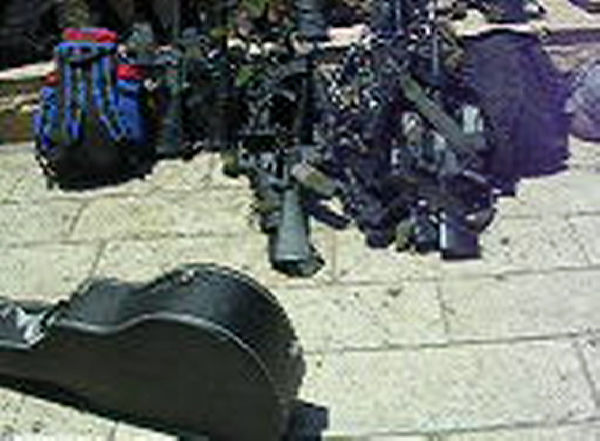
By now it must have been 1 or 2pm, and the square was somewhat busier. Another glaring difference was the presence of a large number of soldiers. They were scattered all about the square and as I walked around the perimeter I came across a sight that caused me to stop and think. Sitting on some steps on one edge of the square were a couple of soldiers. Shaven headed, wearing combat fatigues, basking in the sun. In front of them was a pile of sub-machine guns, maybe 20 or so, piled high, barrels pointing up. I looked over my shoulder at the Wall. And back at the pile of rifles. Back at the soldiers. Guns. Wall. I started to laugh, but something inside me told me I wasn’t laughing because it was funny. I figured that the soldiers must have been watching me out of the corner of their eyes. At least, being so highly trained, I hoped that they’d spotted me! Otherwise, it occurred to me, all those billions of dollars in US aid to the IDF really didn’t equate to value for money. One, directly in front of me, was leaning back on one arm, sunglasses on, pretending not to notice me staring at the guns. After a while, I put my guitar case down, and fished inside my backpack for my digital camera. Taking it out, I asked the young soldier, very politely, if I could take a photo of the pile of guns. He said, much to my surprise, “Sure, go ahead.” One of his colleagues said something to him but he waved away the comments and told me to go ahead. I took a couple of snaps, being careful not to include him in any shots, said thanks and moved away. With all my heavy luggage.
I walked back down to the Wall again. This time there were more people standing next to it, praying. I took a yarmulke, walked over to an empty spot and placed my hand on it again. The tears came again, but not as intensely this time. Slower, more solemnly. I noticed that the cracks between the stones were filled with little folded pieces of paper. I’d heard about the prayers left by the faithful in this way, and after a little thought I pulled out a pen and ripped out a page from the little notebook I carried in the bag. Writing as neatly as I could, I set down a message, folded the paper and placed it within a crack, making sure that it was lodged securely in place. What I wrote on that little piece of paper will forever be between me and my God.
I had noticed that next to me, on my left, was a young, heavy-set bearded man praying with tefillin (small black boxes containing scrolls inscribed with Biblical verses that are worn on the forehead) and, at his feet, a few inches away from me, lay a rifle. I figured it was “locked and loaded”. I’m pretty good at putting two and two together so I also (correctly) figured that he was an off-duty soldier. It occurred to me just how bizarre this scene was. Both of us in the presence of our common God, praying in our own way. His, an age-old, prescribed tradition. Mine, an intimate and very private conversation, a chat, as if I were talking to an old friend. One to whom I owed much, a huge debt of gratitude, and for whom I felt a profound longing to be with again. Perhaps I had waited lifetimes to commune in this way, here at this place. And I have to say, I found the presence of his gun, right by the Wall itself, deeply disturbing and saddening. With a sigh, I realised that it said a lot about this land, where God and bloodshed seem to have a confusingly long and fruitful relationship. Even a cursory reading of Biblical texts shows that warfare seems to have been a particularly popular pastime for the ancients. I think we, in a less barbaric age and with all our basic needs met, just don’t realise how brutal the environment was in this part of the world back then. The fight for basic resources, food, water, shelter, was a daily and immediate reality and I have a suspicion that old habits die-hard in this part of the world (in the time since I originally wrote this piece I've come to the conclusion that war is an inherent part of man's nature).
As if to drive this thought home, I noticed more and more soldiers entering the square. It turns out that there was a swearing in ceremony for the IDF (I’m not sure if this is a regular thing, or a special occasion). I thought it was ironic that there was a to be a military blessing here, within the shadow of the Wall, close to the presence of “God”. Which God? Who’s God? My God? My god doesn’t want anyone to kill anyone else for anything. Of that, I’m pretty sure. Or delusional. Yet here they were, about to take an oath to protect their land against an age-old enemy. The word “Palestine” is a modernisation of “Philistine”, the tribe who were amongst the most feared of the ancient Israelites enemies. In fact, David, the first Israelite Warrior King (or “messiah), achieved heroic status because he defeated the Philistines most feared fighter, Goliath. Even Jesus was encouraged to take up arms by Simon the Zealot. In fact, fundamentalist Christians and Muslims are expecting him anytime now, heading a great celestial army that’ll wipe out the heathens once and for all. In roughly the same spirit, for the Jews to accept a messiah he (or she?) would have to be a military leader as well as a religious redeemer for all Israel. So invoking the might of god to help your army achieve a swift and hopefully brutal victory during warfare is nothing new in the Abrahamic traditions. In my more facetious moments, I imagine that we may well have invented a god for just such a reason. As well as for making sure that little children go to bed on time, eat all their greens and don’t think too much for themselves.
All of this was going through my head as I stood there, with my hand on the Wall. And then I heard a voice.
“Blessed are the peacemakers.”
I wasn’t sure whom the voice belonged to. Maybe it was my own.
After a while, I slowly became aware of the time, and that I had a plane to catch. The last thing on my list was to see the Al Aqsa mosque and The Dome of the Rock, or Masjid Al Haram Al Shaarif.
When I arrived at the ramp that leads up to the level where the Dome of the Rock is situated, I found that the gates were actually closed for lunch! So I had a slight dilemma. Should I wait, have a swift and hurried look and then catch a last minute taxi to the airport, or should I get going and arrive at the airport with plenty of time to spare? I took a look around me. People milling around, more and more arriving every second. Soldiers gathering in the square, some arriving with heavy backpacks loaded with all their military equipment. The shafts of sunlight falling on the stones of the Wall. I asked myself if I would ever be here again, in this life. I decided to stay and wait (after all, I might never get a chance to see The Dome of the Rock again).
As I stood there, surrounded by my bags and with my heavy guitar case at my feet, I thought back over the last few days. I’d seen so much, met so many people, heard so many stories of pain and suffering from people on both sides of the divide. I’d met Palestinians who just wanted running water and the freedom to move around their land. I’d also met Palestinians who were almost certainly dedicated to the destruction of Israel. I’d met Israelis who wanted nothing more than a fair deal for everyone, and peace in the land they called home. And I’d met an Israeli fresh out of the army who thought the Palestinians were animals that deserved to die. I’d looked out over the rolling hills of “The Holy Land” and asked myself, just what makes this land so holy? All the prayers? The presence of “God”? The souls of the people who live here? All the blood spilt? What? The sand is just as dry, the trees just as green, the sky just as blue, the people just as sad, and their eyes just as beautiful as any other place and peoples on Earth. So why was this place holy? To top it all off, here was I, trying to make some sense of it all, and to do my bit. Although, truth be told, I wasn’t sure what “my bit” was…
Finally, the gates were opened and the small group that had been waiting were allowed in. The long ramp led up to the plaza on which the mosques stood. As I entered the plaza the first thing I noticed was that the Al Aqsa mosque itself was quite small, and at one end of the area. I looked to my left and there, gleaming in the sun was the golden dome of the Masjid Al Sharif. It was huge, and quite beautiful. The whole area was beautifully landscaped, with trees and walkways. I knew I didn’t have enough time to actually go into the buildings, so I walked towards the Dome, hoping to take some pictures and get a good, albeit quick, look. I stood there, staring up. This was where Mohammed had been “taken up” to heaven. Where Abraham had offered his son, Isaac, up to “God”. Where the “Glory of the Lord” had filled the Holy of Holies in the first Temple of Solomon.
An old Arab man came up to me and asked if I wanted a tour. I smiled and said thanks but no thanks, as I had to leave shortly. Even so, I gave him a couple of quid and had a quick chat. It amused me that I had noticed a difference between the Arabs and the Jews in the area around the temple: the Arabs were all trying to sell me something whereas the Jews were all either praying or carrying guns! Commerce, God and war. A winning combination, to be sure.
Sitting here, thinking back on my feelings as I left Jerusalem, I’m reminded of a scene from the 1972 film version of “Jesus Christ Superstar”, a film whose music and lyrics had a massive impact on me as a child, as they explore a very different side of the Jesus story. With wicked riffs and smart ass lyrics! One say I'll write a longer piece about why I think this film s a work of great spiritual importance but what Jesus says after Simon The Zealot, and the masses he represents, have lobbied Jesus to take on the mantle of military leader (as Messiah is traditionally expected, and prophesied, to do) and he refuses and rejects violence. Jesus is left by himself in the ruins of a desert village and sings a song to Jerusalem:
Neither you, Simon, nor the fifty thousand,
Nor the Romans, nor the Jews,
Nor Judas, nor the twelve
Nor the priests, nor the scribes,
Nor doomed Jerusalem itself
Understand what power is,
Understand what glory is,
Understand at all,
Understand at all.
If you knew all that I knew, my poor Jerusalem,
You'd see the truth, but you close your eyes.
But you close your eyes.
While you live, your troubles are many, poor Jerusalem.
To conquer death, you only have to die.
You only have to die.
I took one last look at the area, and promised myself I would come back one day. The tears welled up in my eyes again, and something inside me felt sad at the thought of leaving Jerusalem. I gathered up my bags, and once again, with guitar in hand, made my way out of the Dome of the Rock area and walked down to the main Wall precinct. I walked through the square and up to the road, which lies at the southern end of the Old City, and I hailed a cab. The cab driver stepped out to help me with my bags. He was a thin, wiry guy in his 30’s, with a cigarette in his mouth and wide, sly grin. I had a strong feeling that this cab ride was going to be interesting.
As I climbed into the front seat, I looked back over my shoulder, for one last glimpse of the Wall.
I couldn’t quite see it.